
Welker's Accu/Line™ Methanol Injection System delivers continuous, proportional-to-flow methanol injection to prevent hydrate plugs as pipeline flow and conditions change.
Hydrates Can Stop Gas Flow, Even Above Freezing
Under the right pressure and temperature, water in natural gas locks around gas molecules and forms hydrates: ice-like solids that build on the pipe wall, restrict flow, and can plug a line completely. Hydrates need three conditions to form.
Free Water
Natural gas often carries water vapor. As the gas cools, that vapor condenses into free water, the raw material for a hydrate.
High Pressure
Higher line pressure raises the temperature at which hydrates can form, so high-pressure lines enter the risk zone sooner.
Low Temperature
Cold ambient conditions and the cooling that occurs at pressure cuts push the gas stream into the hydrate-forming zone.
Remove one condition and hydrates can't form.
Operators can't always control pressure or weather. Methanol injection targets the water, changing how it behaves so hydrates can't take hold.
~7°F
Typical gas cooling for every 100 psi of pressure drop across a regulator, control valve, or choke.¹
~62°F
Hydrates can form at temperatures this warm when water is present at typical high-pressure pipeline conditions around 1,000 psi.
1 Plug
Is all it takes to stop flow, trap pressure behind the blockage, and force an unplanned shutdown.
¹ Common industry rule of thumb for natural gas at typical pipeline conditions (Joule-Thomson effect); actual cooling varies with gas composition, pressure, and temperature.
Methanol Moves the Hydrate Line Out of Your Operating Range
Methanol is a thermodynamic hydrate inhibitor. Injected into the gas stream, it mixes with free water and lowers the temperature at which hydrates can form, so the line has to get much colder before hydrates are possible.
It is one of the longest-standing and most widely used hydrate-prevention methods because it is simple, effective, and can protect a site without dedicated gas dehydration equipment.
Where operators inject methanol
Upstream of regulators, control valves, and other pressure cuts
City gate, town border, and meter stations
Wet gas gathering and transmission lines
Above-ground piping exposed to cold weather
Onshore and offshore production facilities
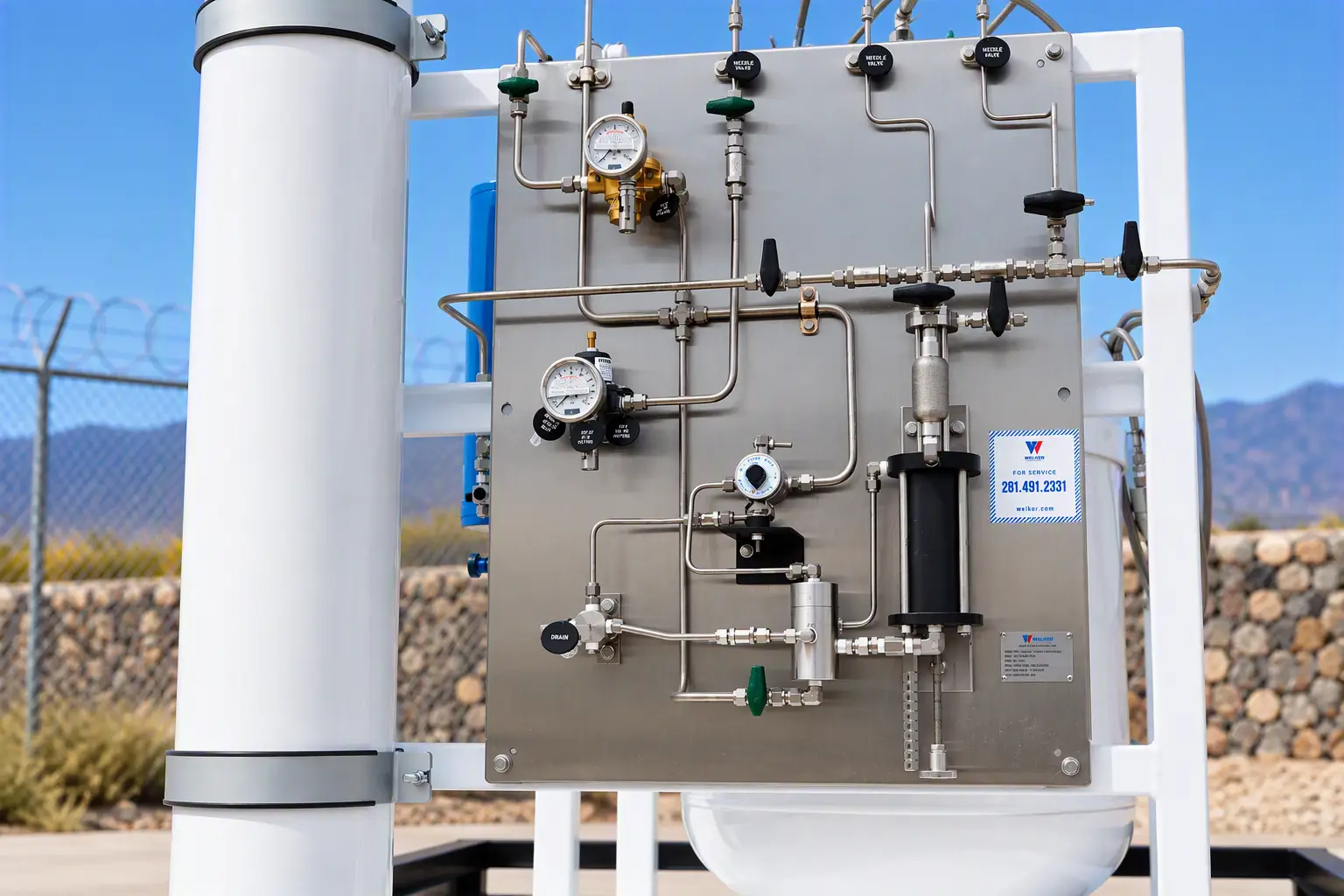
Accu/Line™ · Proportional to Flow
Why the Injection Rate Matters
The Right Dose Protects the Line. The Wrong Dose Costs You.
Too Little Methanol
Protection is incomplete. When flow increases or temperatures drop, the line can slip back into the hydrate zone, leading to freeze-offs, plugs, and unplanned downtime.
Too Much Methanol
Chemical is wasted, refill trips and operating costs climb, and excess methanol travels downstream with the gas and liquids.
Free Water
Natural gas often carries water vapor. As the gas cools, that vapor condenses into free water, the raw material for a hydrate.
Built for Operational Continuity
Control, Visibility, and Redundancy
The system combines automated injection control with communication, logging, and pump redundancy to support field operation and troubleshooting.
Intuitive Touchscreen Control
Adjusts injection rate in response to changing flow conditions.
Modbus or Ethernet
Supports remote communication and integration with existing monitoring infrastructure.
Redundant Self-Priming Pumps
Dual pumps with automatic failover help maintain continuous operation.
Time-Stamped Audit Trail
Historical records and alarms are logged and backed up to a microSD card.
Proportional-to-Flow Injection
Chemical delivery tracks pipeline flow rather than remaining at one fixed rate.
Configurable Power
Optional solar power supports applications where conventional power is limited.
From Flow Signal to Controlled Injection
01
Receive Flow Input
The controller receives the available pipeline flow signal.
Flow Signal
02
Calculate the Rate
The control logic determines the required proportional methanol rate.
Touchscreen Controller
03
Inject Methanol
A self-priming pump delivers methanol into the flowing gas stream.
Redundant Pumps
03
Log and Communicate
Operating history and alarms are recorded, with remote communication available.
Modbus · Ethernet · microSD
Designed for Natural Gas Flow Assurance
Use the Accu/Line™ Methanol Injection System where hydrate risk and changing gas flow require controlled chemical delivery.
Upstream of Regulators
Protect regulator and control-valve runs where gas cooling from the pressure drop creates hydrate conditions.
Transmission & Distribution
Maintain hydrate protection across changing pipeline demand.
Onshore Operations
Apply automated injection and remote visibility at field installations.
Offshore Operations
Support operating continuity where reliability and remote communication matter.
Accu/Line™ at a Glance
Final sizing and configuration are confirmed by Welker using your flow, chemical, signal, power, environmental, and installation requirements.
Proportional to flow
Dual, self-priming, automatic failover
Modbus or Ethernet
Time/date-stamped history and alarms
Touchscreen controller
Application-specific; solar optional
What Welker Needs to Configure Your System
Have these ready and our team can size and configure your system faster.
Process
Minimum, normal, and maximum gas flow
Pipeline operating pressure
Required methanol injection basis
Controls
Available flow signal
Remote communication protocol
Alarm and data requirements
Site
Available power
Area classification
Ambient and installation conditions
Methanol Injection Questions
Why is methanol injected into natural gas pipelines?
To prevent hydrates. Methanol mixes with free water in the gas stream and lowers the temperature at which hydrates can form, keeping the line out of the hydrate-forming zone so gas keeps flowing.
Do hydrates only form in freezing weather?
No. Hydrates are not ice. When free water is present and line pressure is high enough, they can form at temperatures well above 32°F.
Where is methanol typically injected?
Most often upstream of a pressure cut, such as a regulator or control valve, where the pressure drop cools the gas. It is also used on wet gas lines and piping exposed to cold weather.
Why use proportional-to-flow injection?
Pipeline demand changes. Proportional control increases or decreases chemical delivery with flow, helping avoid a fixed rate that underfeeds at high flow or wastes methanol at low flow.
What happens if the active pump has a problem?
The redundant pump arrangement supports automatic failover to help maintain continuous operation.
Can the system be monitored remotely?
Yes. The system supports Modbus or Ethernet communication for remote integration, monitoring, and troubleshooting.
Build the System Around Your Pipeline.
Share your flow range, injection requirements, available signal, power, and installation conditions. Welker will confirm the system configuration.
