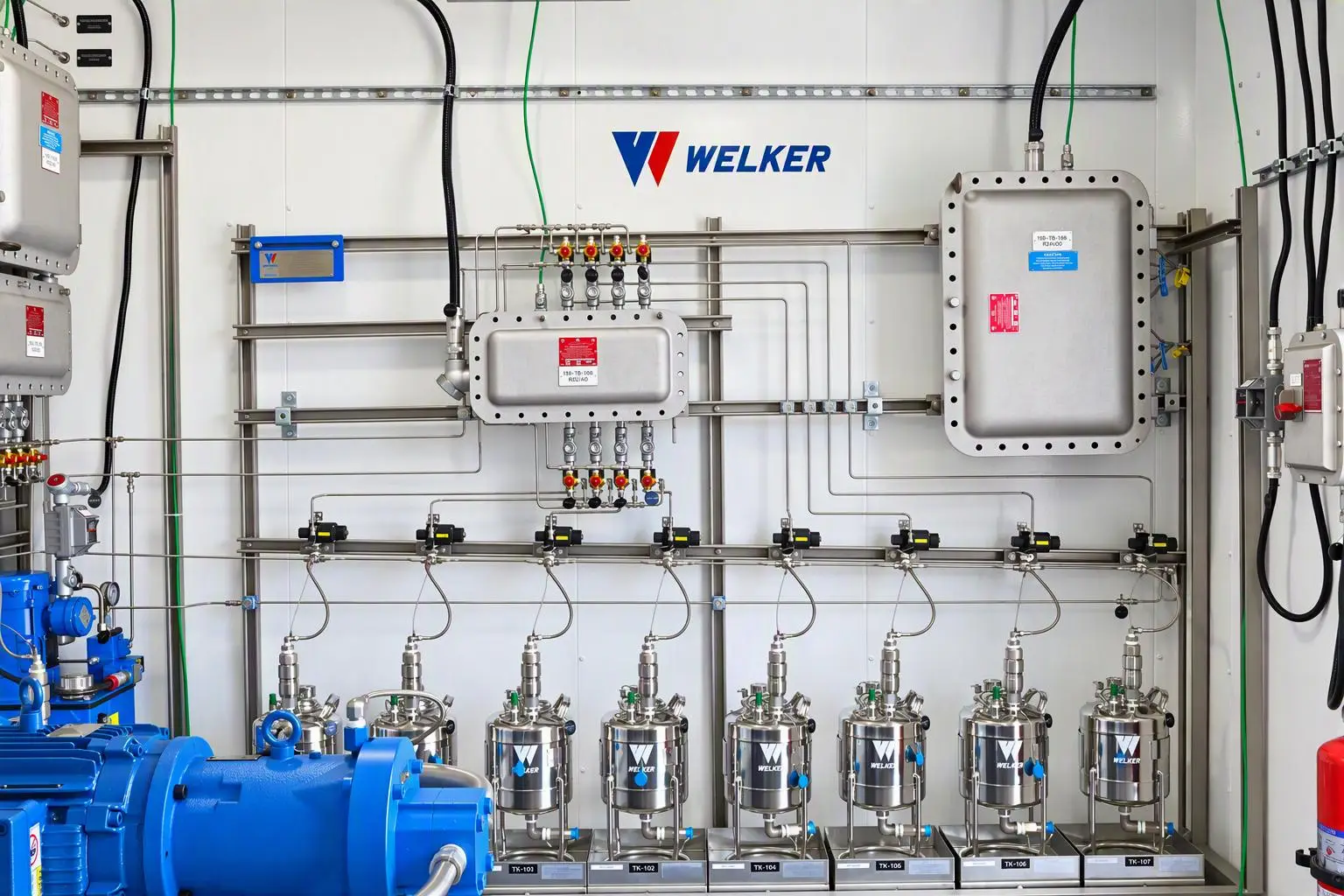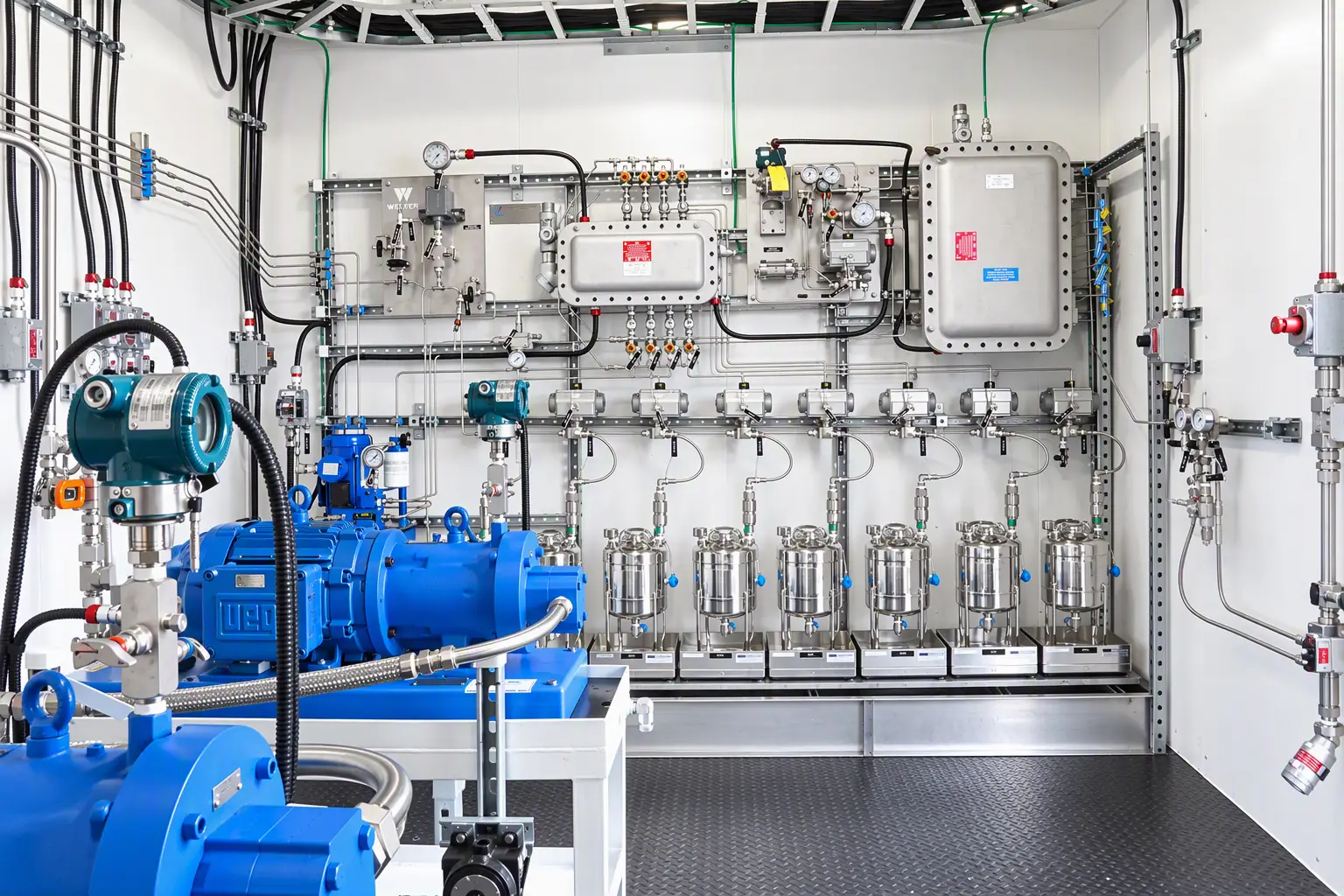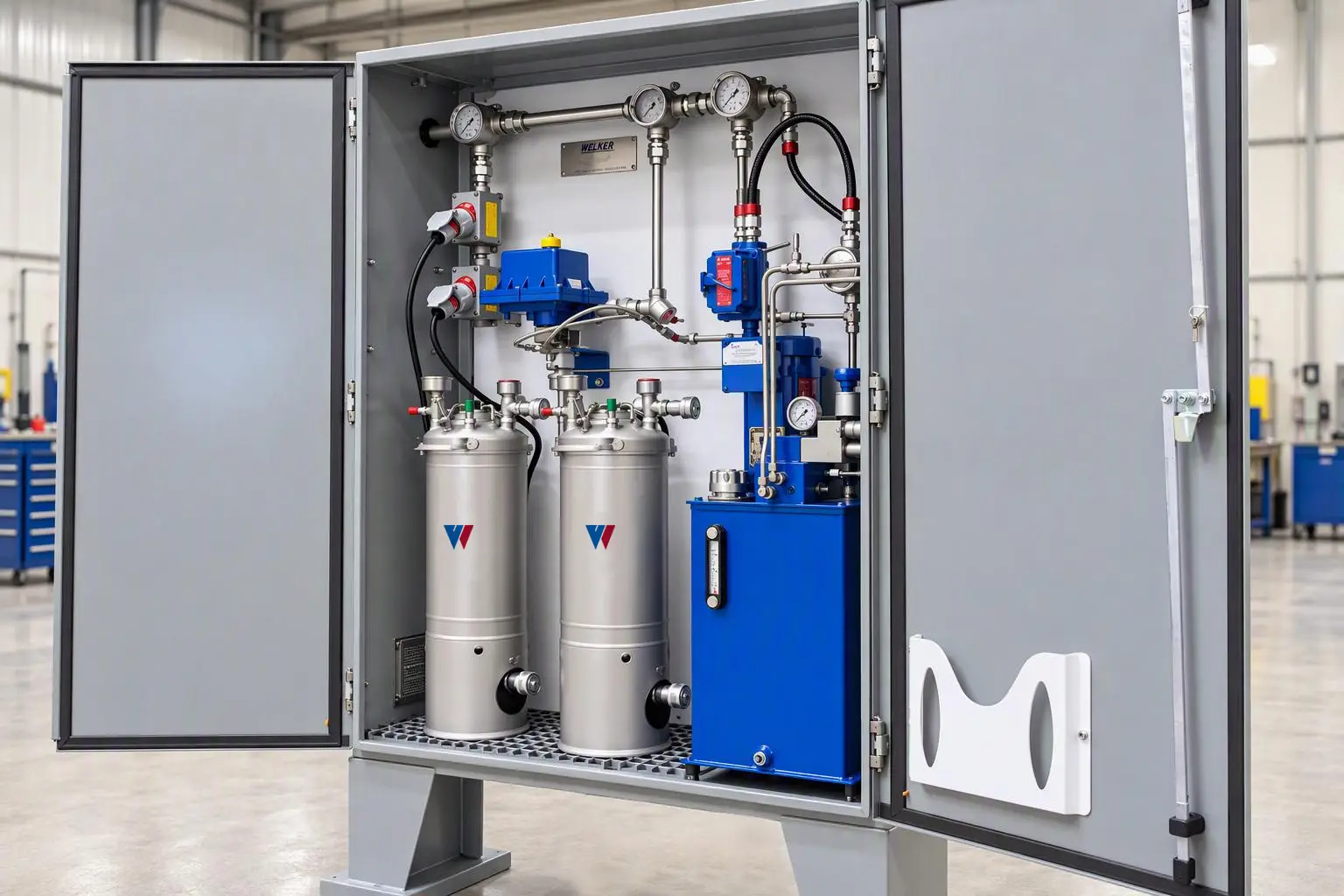
Complete automatic sampling systems — samplers, containers, mixers, panels, and controls — designed, manufactured, assembled, and tested by Welker. Delivered in an enclosure, on a skid, or inside a building.
ISO 3171 | API 8.2
Representative Samples. Reliable Results
Accurate BS&W and crude oil quality results start with a representative sample. Welker integrates sampling, mixing, and sample handling to help preserve sample integrity from pipeline to lab.
Isokinetic Sample Extraction
inFlow™ samplers collect representative samples from the conditioned pipeline stream.
Mixing Solutions Tailored for Your Application
Static, fast-loop, and WelMix™ solutions are selected for your flow rate, viscosity, and water content.
Sampling Containers for Every Crude
A range of sampling containers, Including the TCC Optimum™ — the only crude oil container with DOT and Transport Canada approval — and constant-pressure options for live crude.
Closed-Loop, Emission-Conscious Design
Fully closed-loop sample handling protects operators and the environment while preserving sample integrity.
Designed & Built in Sugar Land, TX
From initial application review to system engineering, fabrication, FAT, commissioning, and support, Welker brings the entire crude oil sampling system together under one roof.One integrated system.
One experienced team. Confidence from pipeline to lab.
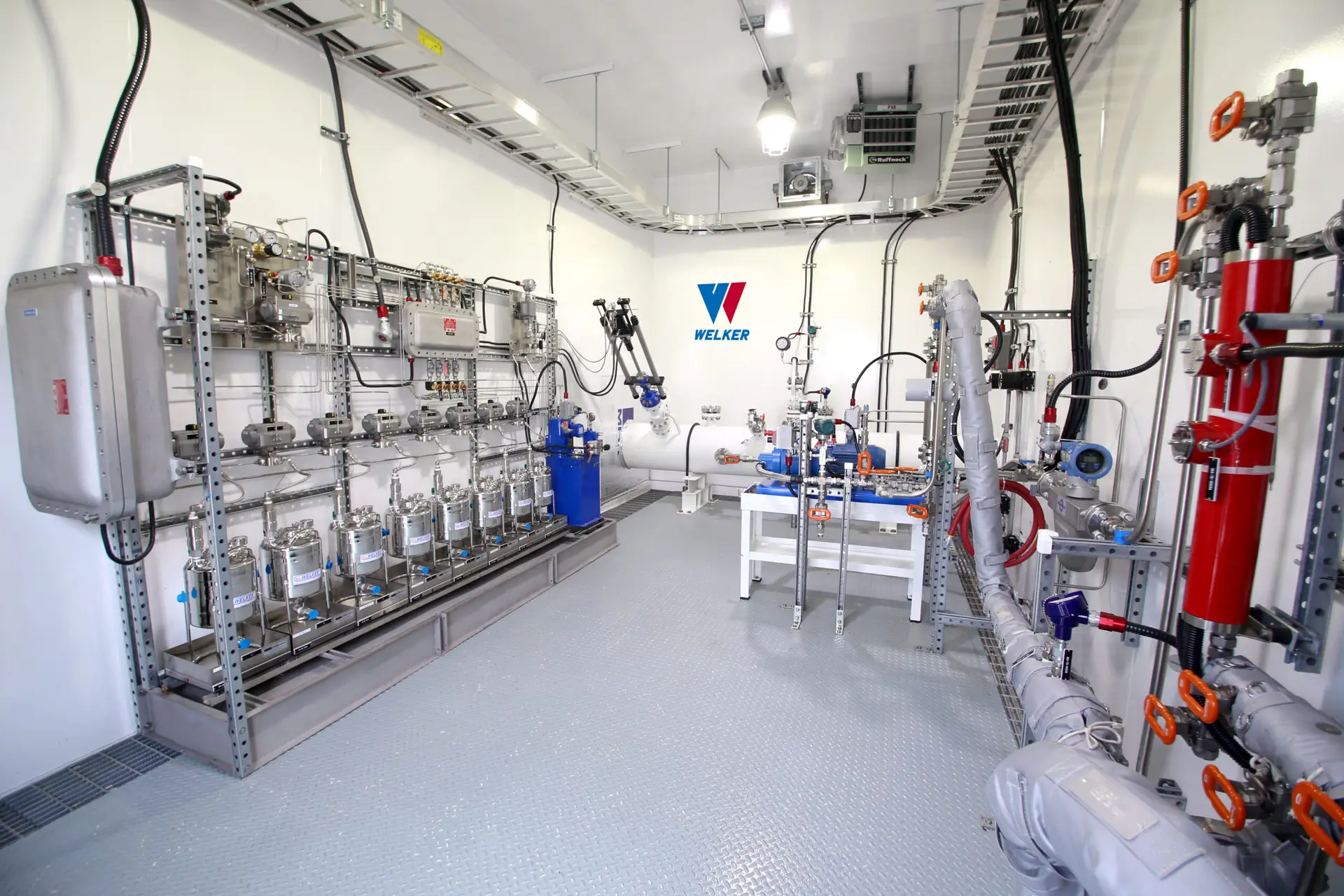
Analyzer Building · Power Mixing & Multi-Receiver Sampling
Your Site. Your Package.
Enclosure, Skid, or Building
Every Welker crude oil sampling system is delivered turnkey — piped, wired, and tested before it ships — in the package that fits your footprint, climate, and operating model.
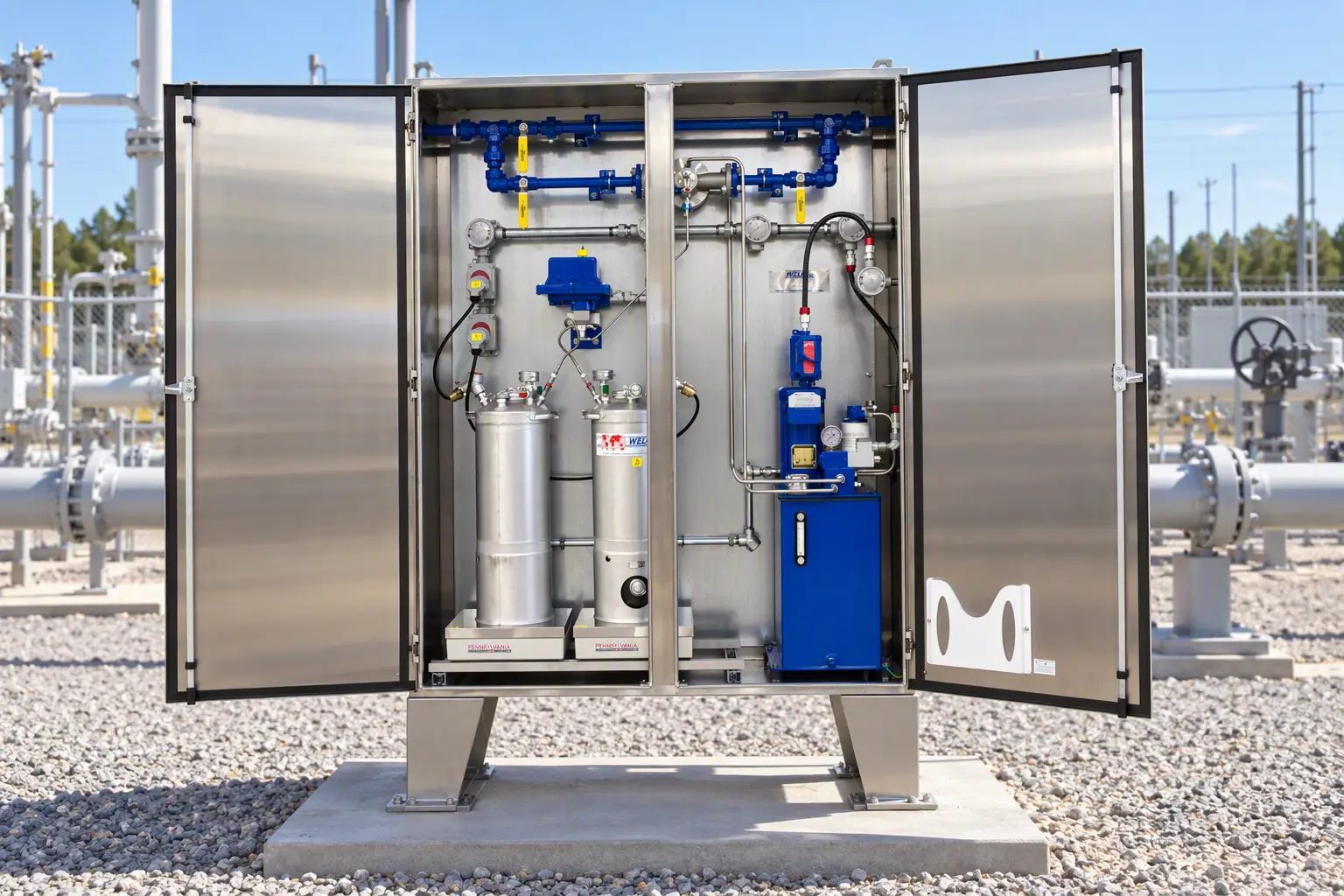
Enclosure
Sampling Enclosure
A compact, self-contained cabinet that protects the sampler controls, receivers, and power unit at LACT units, meter stations, and remote pads.
Small footprint, fast installation
Stainless steel construction
Optional heating for cold climates
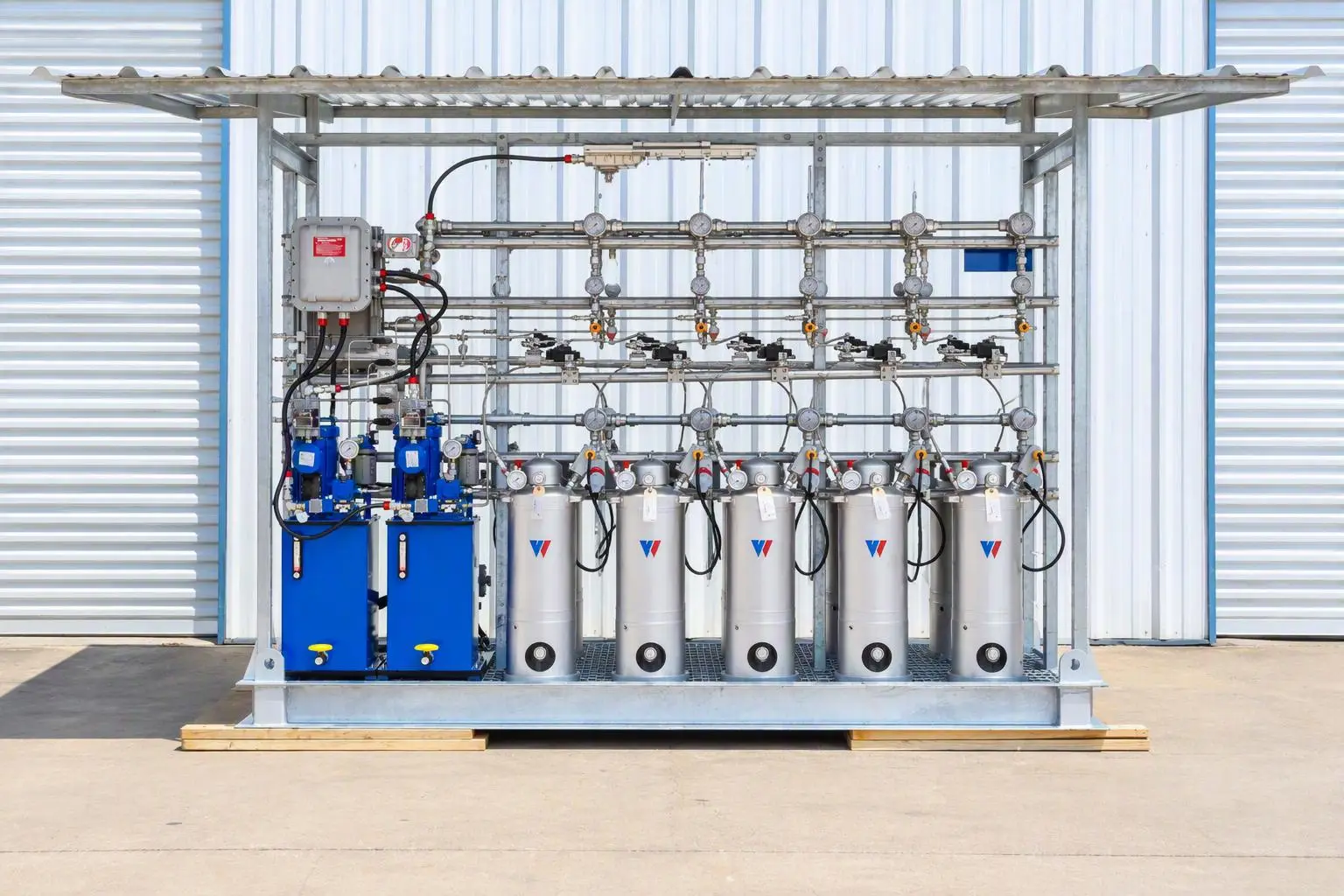
Skid
Skid-Mounted Systems
A structural skid — with optional canopy — that carries multiple receivers, redundant power units, and integrated controls for terminals and pipeline stations.
Multi-receiver & redundant designs
Single lift, minimal field work
Canopy or open-frame options
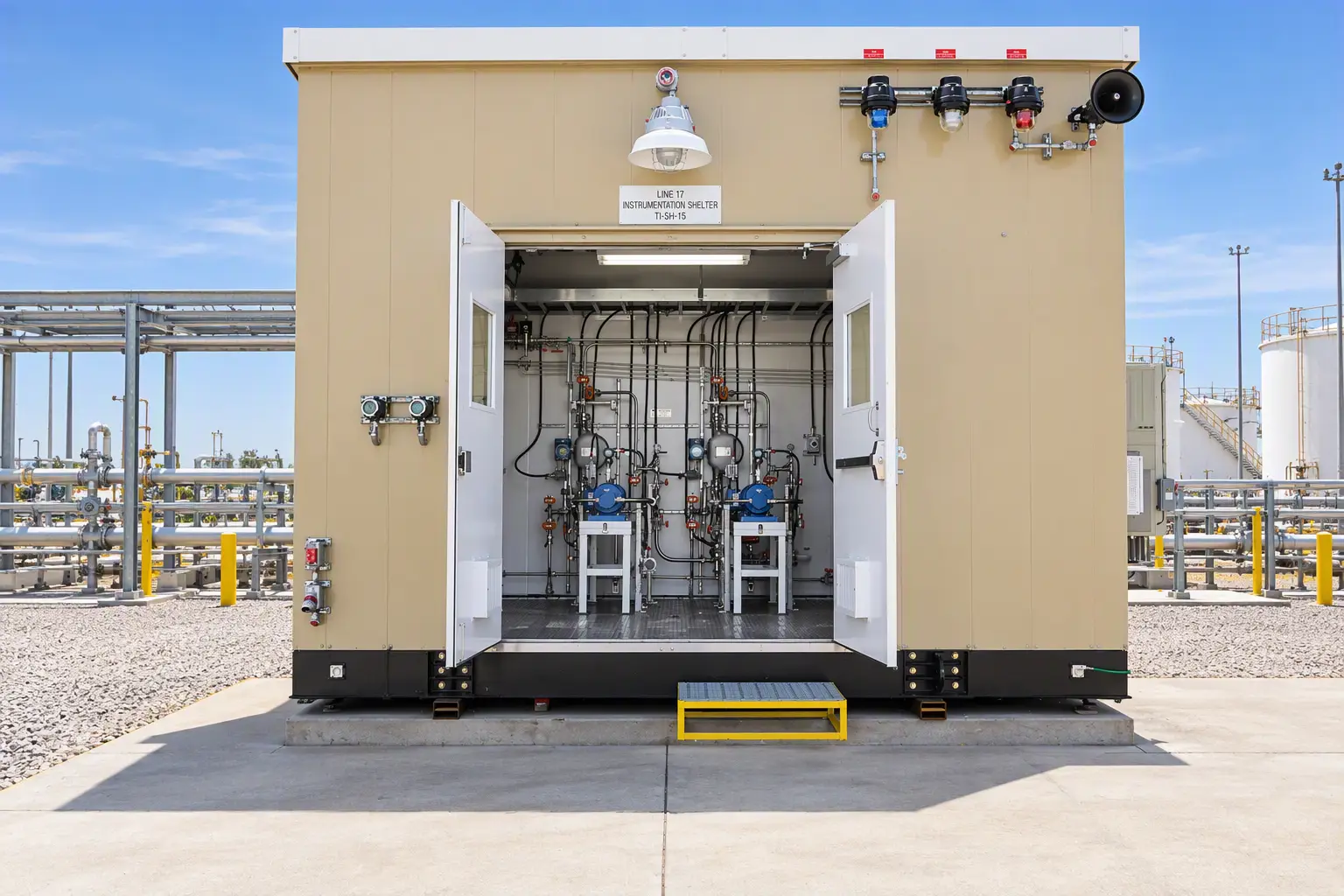
Building
Analyzer Building
A climate-controlled, walk-in building for fiscal metering points that integrates the sampling loop, power mixing, analyzers, and sample handling under one roof.
HVAC, lighting & gas detection
Analyzer & densitometer integration
Ideal for terminals & export facilities
How It Works
From Pipeline to Laboratory in Six Steps
An automatic sampling system per API MPMS 8.2 combines flow conditioning, extraction, control, collection, and sample handling. Welker manufactures every one of them.
01
Flow Conditioning
The pipeline stream is homogenized so water and sediment are evenly dispersed at the sample point — using static mixing, a fast loop, or power mixing.
WelMix™ · Static Mixing Spool
02
Isokinetic Extraction
A Welker sampler inserted into the center third of the line, or into a fast loop, removes precise sample grabs at line velocity.
inFlow™ · inFlow™ ACE · inLoop™ ACE · FLP
03
Flow-Proportional Control
The controller paces each grab to meter pulses so the composite represents the full batch, with optional data logging and receiver monitoring.
04
Composite Collection
Grabs are delivered to a sample receiver sized for the batch — atmospheric for stabilized crude or constant pressure for live crude.
TCC Optimum™ · TCC · SCC · CP-2
05
Sample Mixing
Stratified composites are re-homogenized in a closed loop so the laboratory subsample matches the contents of the whole container.
06
Laboratory Analysis
The representative subsample is tested for BS&W, density, and quality — the results that settle custody transfer and allocation.
BS&W · Density · Quality
System Configurations
Three Proven Sampling Architectures
Welker engineers select the architecture based on line size, flow range, crude properties, and the measurement uncertainty your contract requires.
Inline Sampling System
0.118%
Typical measurement uncertainty
The sampler is mounted directly on a well-mixed main line. A simple, proven, low-cost solution.
Best for
LACT units, gathering, well-mixed lines
Key Equipment
inFlow™ / inFlow™ ACE, static mixer, receivers
Fast Loop Sampling System
0.035%
Typical measurement uncertainty
A continuous bypass loop keeps the sample live and turbulent, then returns excess crude downstream.
Best for
Mixed pipelines, high pressure, densitometer integration
Key Equipment
inLoop™ ACE, pump, purge valve, receivers
Highest Accuracy
WelMix™ Power Mixing System
0.025%
Typical measurement uncertainty
Combined jet mixing and sampling homogenizes the line at any flow rate — with no pressure loss in the main pipeline.
Best for
Fiscal transfer, export docks, low-flow & heavy crude
Key Equipment
WelMix™ pump & nozzle, cell sampler, receiver changeover
*Typical values; actual system uncertainty depends on pipeline conditions and is confirmed during Welker engineering review and proving.
Built from Welker Components
Every Part of the System. One Manufacturer.
Welker turnkey systems are built around our own crude oil samplers, containers, mixers, and panels — so performance, spare parts, and support come from a single source.
Remove precise sample increments from a flowing pipeline for collection in a composite sampling system.
All SamplersinFlow™ ACE
Patented main-line sampler with adjustable sample volume, shaft and seal protection, and purge tube.
inLoop™ ACE
Repeatable fast-loop sampling of light and medium crude oil and refined hydrocarbons.
inFlow™ Crude Oil Sampler
The main-line isokinetic extractor with adjustable insertion and multiple collection heads.
inFlow™ (Fixed)
Fixed insertion for 2"–4" lines, bypass loops, separators, and LACT units.
System Configurator
Find Your Crude Oil Sampling System
Answer three questions and we'll point you to a starting configuration. Our engineers confirm every detail during design review.
Field-Proven Projects
Crude Oil Sampling Systems We've Built
From single-point enclosures to complete analyzer buildings, every system is fabricated and tested at Welker before it ships.
Standards We Design To
API 8.2
API 8.3
ISO 3171
ASTM D4177
IP/EI 6.2
Why Welker
One Source for the Entire Sampling System
Many sampling systems are assembled from multiple vendors' components. Welker designs and manufactures the core equipment in-house — and stands behind the complete system.
FAQ
Crude Oil Sampling Questions
What is a crude oil automatic sampling system?
An automatic sampling system extracts small, flow-proportional grabs from a flowing pipeline and collects them into a composite sample that represents the entire batch. Per API MPMS 8.2, it includes flow conditioning, an automatic sampler, a controller, a flow measuring device, a sample receiver, and sample handling and mixing.
Which standards do Welker crude oil sampling systems meet?
Welker designs systems to API MPMS Chapter 8.2, ISO 3171, ASTM D4177, and IP/EI 6.2 as specified, with sample mixing and handling aligned to API MPMS 8.3.
Inline, fast loop, or power mixing — how do I choose?
Inline systems suit well-mixed main lines. Fast loop systems keep a live, turbulent sample stream for mixed pipelines and analyzer integration. WelMix™ power mixing homogenizes the line at any flow rate and delivers the lowest measurement uncertainty for fiscal transfer points. Our engineers make the final recommendation after reviewing your process data.
Can the system be delivered in an enclosure, on a skid, or in a building?
Yes. Welker delivers turnkey systems in stainless enclosures, structural skids with optional canopies, and climate-controlled analyzer buildings — fully piped, wired, and tested before shipment.
What information do you need to size a system?
Pipeline size and orientation, flow and pressure ranges, crude properties (density, viscosity, water, H₂S), hazardous area classification, available utilities, receiver preferences, and the standard you must comply with. Our Crude Oil Sampling Worksheet captures everything in one place.
Ready to Spec Your Crude Oil Sampling System?
Send us your process conditions and our engineering team will recommend the right architecture, components, and package.