
Turnkey, skid-mounted composite and spot sampling for refined-product batches and blends. Samplers, LS constant pressure receivers, draw-off panels, and controls, all engineered, built, and tested together by Welker.
Your Batch Is Only as Good as Its Sample.
Gasoline, diesel, jet fuel, and blendstocks move in batches, often back-to-back in the same line. Every batch must prove it is on spec before it changes hands, and that proof comes from the sample.
A Welker Refined Product Sampling System takes flow-proportional composites across each batch, holds them at line pressure in LS constant pressure receivers so light ends stay in the sample, and gives your team an enclosed, backlit station to fill lab bottles and Boston round spot samples.
One Skid. One Manufacturer.
The samplers, receivers, draw-off panels, and controls are designed and built by Welker, then piped, wired, and tested together on one skid. Set it, connect the fast loop, power, and air, and start sampling.
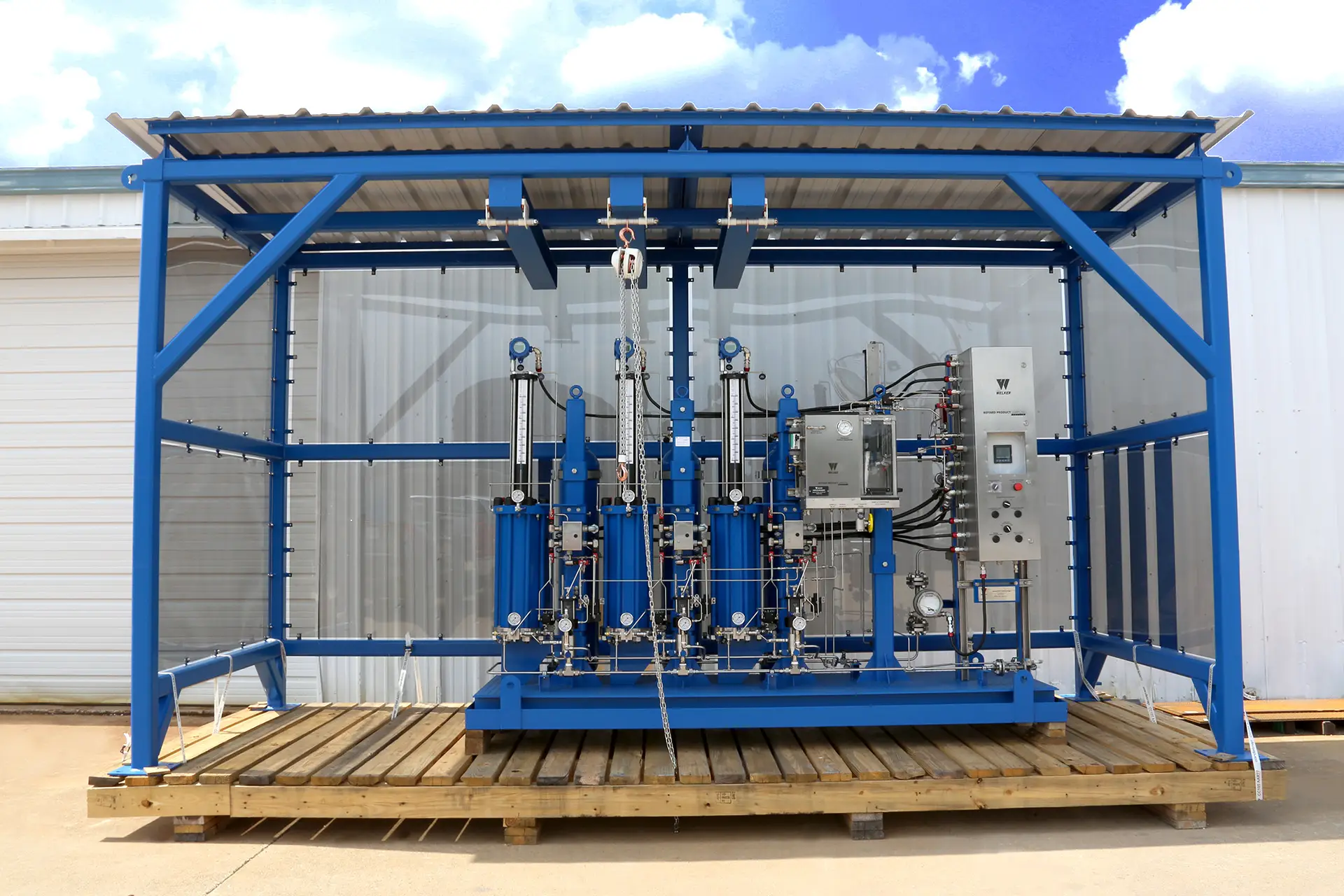
Turnkey · Tested Before It Ships
Head. Middle. Tail. Or Whatever Your Program Calls For.
Quality can shift from the front of a batch to the back. Separate composites for each segment show exactly what moved through the line.
Head
The leading portion of the batch, where it meets the product ahead of it. One LS receiver collects the head composite.
Middle
The body of the batch and most of the product delivered, kept separate from both interfaces.
Tail
The final portion of the batch, where it meets the next product, so you can verify quality to the end.
One composite per batch · two receivers for two segments or alternating batches · a total composite alongside a period (e.g., 8-hour) composite · and spot samples on demand into a Boston round bottle.
Everything You Need to Sample a Batch
Every skid is configured to your line, products, and lab. Most include these six building blocks.
Composite Samplers
Welker sample pumps take small, repeatable grabs proportional to flow, with externally adjustable volume and a seal leak detection manifold. Coriolis sample flow meters are available to verify every grab.
0.25–7.5 cc per GrabLS Constant Pressure Receivers
Each composite is held at line pressure behind a nitrogen pre-charge so light ends stay in the sample. Push-button mixing readies it for draw-off, and purge/drain resets it for the next batch.
3, 5, or 8 US gal @ 80%Spot Sample System
A dedicated spot sample pump delivers a set volume of flowing product into a Boston round bottle on demand, for verification and comparison testing.
Adjustable 10–1000 ccDraw-Off Panels
Enclosed, backlit panels with product throttle valve, eductor purge, and containment drain. Chilled glycol panels, palm-button container lift, and a separate spot panel are available.
Standard or ChilledControls
A Welker digital display controller with receiver selector, mix/purge, draw-off, and PLC interlocks. Or wire every solenoid and transmitter straight to your PLC/DCS through one junction box.
Welker Controller or Direct I/OInstrumentation & Utilities
Level, product pressure, and pre-charge pressure transmitters on every receiver, a fast loop flow meter, instrument air conditioning, hose reel, and a painted carbon steel skid with containment.
DC 24 V · 4–20 mAFrom Fast Loop to Lab Bottle
Four steps, all on one skid.
Circulate
Product flows from your line through the fast loop and back, so the samplers always see fresh, representative product.
Fast Loop · Flow MeterCollect
On a signal from your control system, the sampler for the active receiver takes small grabs proportional to flow.
Composite SamplersHold & Mix
Each composite fills its own LS receiver at line pressure. Before draw-off, push-button mixing makes it uniform.
LS ReceiversDraw Off
Fill your lab container at the enclosed draw-off panel, then purge and drain the receiver for the next batch.
Draw-Off PanelStart From a System We've Already Delivered
Each of these is based on a skid Welker has engineered and built. Pick one to pre-fill the configurator, then change anything.
Chilled glycol panel for a 1 qt container
SpotAdjustable 10–1000 cc spot pump
ControlsWelker controller with PLC interlocks, or direct DCS I/O with Coriolis sample meters
FootprintFrom 48 × 36 in
Head · Middle · Tail
3 × 3 gal ProgramHead, middle, and tail composites
SpotSpot pump set to 355 cc, palm-button container lift
Connections1/2 in Class 300 RF fast loop · 720 psig MAOP
Footprint120 × 36 in
Two banks of head, middle, and tail
Draw-OffThree panels, one dedicated to spot samples (757 cc)
ControlsRuns on your PLC/DCS through one junction box
Footprint180 × 36 in
Tell Us About Your Line. We'll Size the Skid.
Five short steps. Your answers go straight to Welker Sales and Engineering as a complete spec, so we can quote faster with fewer follow-up questions.
Built by the Manufacturer, Not Assembled by an Integrator
When the samplers, receivers, and skid all come from Welker, so does the accountability.
System Snapshot
Typical Specifications
Ranges below come from Refined Product Sampling Systems Welker has delivered. Every skid is engineered to the project, and your final ratings are confirmed on your drawing package.
2, 3, or 6 LS
3, 5, or 8 US gal @ 80%
Adjustable 0.25–7.5 cc
Adjustable 10–1000 cc
275 to 720 psig
-20 °F to 120 °F
Class I, Div 2, Groups C & D (B available), T3
DC 24 V · 4–20 mA · Discrete I/O
Tube Fittings or Class 150/300 RF Flanges
48 × 36 in to 180 × 36 in
Applications
Wherever refined products are blended, batched, or change hands.
Common Questions
What does the configurator send to Welker?
Every answer, plus a recommended starting configuration and any engineering notes, goes to sales@welker.com as one organized spec. You'll get a copy by email, and a Welker specialist follows up with questions only where something is missing.
What if I don't know some of the answers?
Choose “Not sure” or leave it blank. Line pressure, products, and how you sample each batch are the most helpful. Attaching a P&ID or datasheet fills in most of the rest.
Why sample the head, middle, and tail separately?
Quality can change across a batch, especially near the interfaces with the products before and after it. Separate composites let your lab confirm the whole batch is on spec, and show where an issue started if it isn't.
Why use constant pressure receivers?
Gasoline and other light products contain light ends that flash off at atmospheric pressure, which skews vapor pressure and composition results. LS receivers hold the sample at line pressure until it is mixed and drawn off.
Can our PLC or DCS run the system?
Yes. Welker can supply its own controller with PLC interlocks and status outputs, or wire every solenoid, transmitter, and push button to one junction box so your control system runs the sequencing.
What do we need to provide on-site?
A fast loop connection to your line, instrument air, DC 24 V power and signals, nitrogen for the receiver pre-charge (or Welker-supplied bottles), and a liquid recovery point. A glycol supply is needed for chilled panels.
Rather Talk It Through?
Send us your P&ID or call the team that builds these skids. We'll recommend a configuration and stand behind it.
